ARCHIVE FILE
See the original document
Bait Bins for Blowfly Control
Dan Salmon, District Veterinarian, DENILIQUIN
Cutaneous myiasis due to the larvae of the Australian Sheep Blowfly (Lucilia cuprina) is an important problem in all sheep producing areas of Australia.
The spring and summer of 1992/93 was wetter than usual in the Riverina. Blowfly activity was perceived to be greater than usual. In order to get an idea of how severe the fly wave was and also to get information on treatment and preventive programs I mailed a survey to sheep producers within the Deniliquin and Moulamein Rural Lands Protection Districts. 100 producers running more than 500 sheep replied.
The survey indicated that even with preventive chemical application there was a high incidence of flystrike. 90% of producers who had treated sheep prophylactically still had problems with flystrike. 14% of sheep had to be treated because of flystrike. 2% of adult sheep and 5% of lambs died due to flystrike.
There was no significant difference between chemicals or application methods.
At the same time, maggots tested by BCRI Rydalmere (Levott pers. comm.) showed a high level of tolerance and resistance to organophosphates but no tolerance to cyromazine.
This indicated that despite the availability of effective chemicals and application methods there was a major deficiency in the field control of blowfly strike.
One method of blowfly control which had some appeal was the use of bait bins to control fly numbers. In association with the Livestock Officer (Sheep and Wool) I set up a trial to look at the effect of bait bins over the spring and summer of 1993/94.
Bait bins as a means of controlling blowfly numbers were developed at the University of NSW Fowlers Gap Arid Zone Research Station.
As used in our trial, the bins were made from 200l (44 gallon) drums. The drums were painted yellow to attract flies, make them easier to find in large paddocks.
Several rows of 5mm holes were drilled in the sides near the top. The size of the holes is important because the hairy maggot blowflies (Calliphora spp.) cannot get in the smaller holes. Hairy maggots will destroy Lucilia maggots on carrion and so help further in their control.
A dead sheep was used as an attractant with 200g technical grade sodium sulphide in 20% solution as an additional attractant. Once the bin was set up no further attractant was added (the dead flies were the attractant).
40g trichorphon in 4% solution was the insecticide used. It was replaced every two weeks.
Two mobs of sheep were observed. Each contained approximately 2000 weaned merino lambs running on approximately 1600 hectares of native grassland. One group had a bait bin maintained on a creek near a watering point.
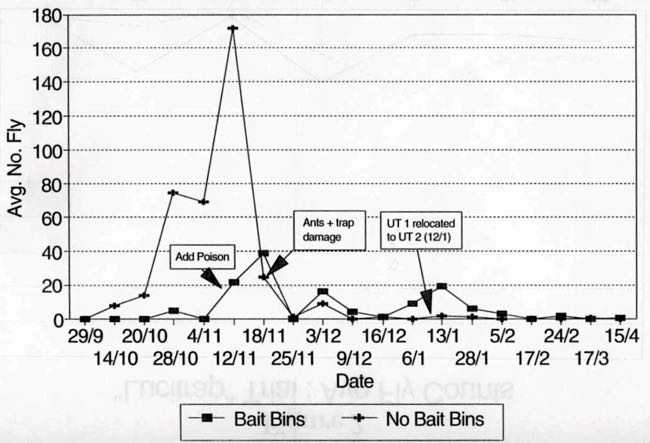
Fly numbers were estimated using smaller traps baited with sheep liver. There were three traps in each paddock. The flies trapped over a 24 hour period were collected, identified and recorded. The results are shown in Figure 1.
This indicates dramatically fewer flies in the baited paddock than the un-baited paddock. There was at the same time a much greater prevalence of flystrike in the baited paddock.
In 1994/95 we ran a trial in association with the University of Queensland and Queensland Department of Primary Industries using the Miasma Lucitrap. This is a commercial baiting system using purpose built traps and artificial lures. The traps are smaller and require one per hundred sheep, the lures last about 3 months and no insecticide is used.
This trial required an entire property to be trapped, so almost 250 traps were put out over a 30,000 hectare property. The control area was a smaller property with similar geography and sheep flock some 20 km away.
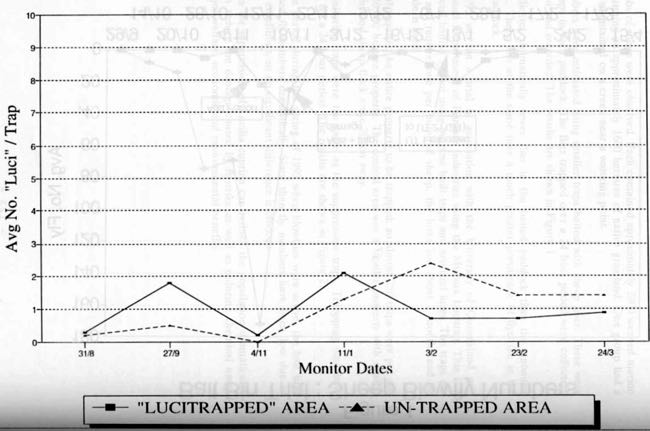
The monitoring traps were the same as the suppression traps. Trapping was done monthly for a 24 hour period. The results are shown in Figure 2.
Over the period during the spring of 1993 when blowflies were active, the bait bins suppressed fly numbers dramatically. Since then fly numbers have been low due to drought conditions, so no significant difference is obvious.
Bait bins for suppression of Lucilia cuprina can reduce the population dramatically. This can reduce the damage caused by flystrike as well as reducing chemical usage with major welfare, economic and environmental benefits.